Cold-Form Alu-Alu vs PVC & PVDC Blister Packaging Selection Guide
Compare moisture WVTR (0.0 vs 0.4 vs 5.0 g/m²/day), oxygen barrier, card size, forming speeds, and per-1,000-blister laminate cost across Alu-Alu, PVDC, and PVC.
Choosing the Right Blister Barrier Without Overspending on Foil
Formulation and packaging teams face a recurring trade-off: plain 0.25 mm PVC is crystal clear, compact, and inexpensive—yet lets 4–6 g/m²/day of water vapor pass straight into blister pockets. Cold-form OPA/Alu/PVC (Alu-Alu) cuts WVTR to virtually 0.0 g/m²/day, but requires larger cards (bigger cartons, fewer packs per shipping pallet) and opaque cavities. Sitting right between them are multi-layer PVC/PVDC (40–120 g/m²) and PVC/Aclar thermoformable high-barrier webs!
Grounded in pharma line sizing and compliance and cgmp barrier and validation specs, match web selection to your API’s hygroscopicity and ICH export destination.
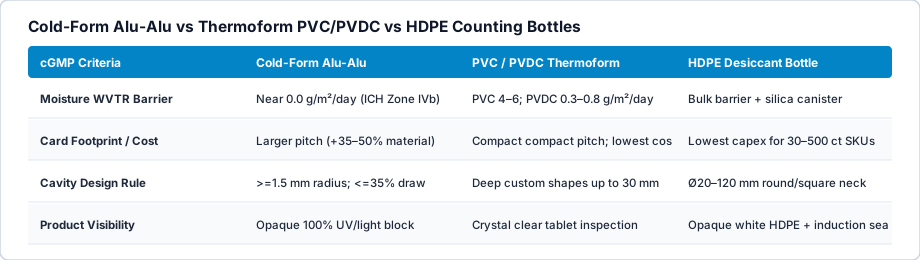
Four-Tier Blister Web Barrier & Economics Comparison
Quantitative comparison across barrier, card size, machine speed, and relative material cost:
| Blister Base Web | WVTR (38 °C / 90% RH) | OTR Oxygen Barrier | Relative Card Area | Relative Material Cost |
|---|---|---|---|---|
| Mono PVC (0.25 mm) | 4.0 – 6.0 g/m²/day | ~20 cc/m²/day | 1.0× (most compact) | 1.0× baseline |
| PVC / PVDC (60–90 gsm) | 0.35 – 0.65 g/m²/day | 0.5 – 1.2 cc/m²/day | 1.0× compact clear | 1.4× – 1.8× |
| PVC / PCTFE (Aclar) | 0.08 – 0.25 g/m²/day | ~7–15 cc/m²/day | 1.0× compact clear | 2.6× – 4.0× |
| Cold-Form OPA/Alu/PVC | <0.005 g/m²/day (~Zero) | <0.005 cc (~Zero + UV) | 1.35× – 1.55× wider | 2.2× – 2.8× |
Calculate exact card dimensions for both options in our blister web layout and speed calculator.
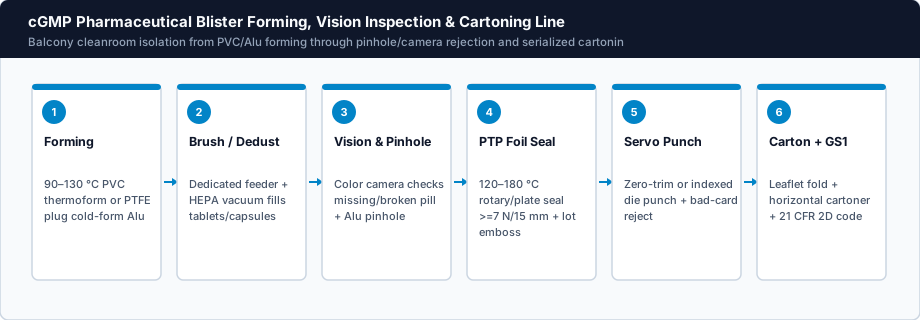
cGMP Cleanroom & Validation Notes
- Oxygen + Light Sensitivity Favors Cold-Form Alu-Alu: Aclar blocks moisture brilliantly while staying transparent, yet its oxygen barrier is modest—molecules sensitive to both oxidation/UV light and moisture (like nifedipine, omeprazole, or clavulanate) belong in cold-form Alu-Alu.
- Dual-Capable DPP-180L / 260 Machines Hedge R&D Risk: Running stability registration batches on both PVDC and cold-form Alu-Alu on one dual-mode DPP machine lets R&D pick the lowest-cost passing structure after 6-month ICH data arrives.
- Carton & Freight Ripple Effect: Because a 10-count Alu-Alu card is ~40% larger in area than PVC, remember to account for larger folding cartons and shippers in total landed cost.
Test Both PVDC & Cold-Form Tooling Options
Share your molecule’s moisture/light profile and target ICH zone via Project Brief.
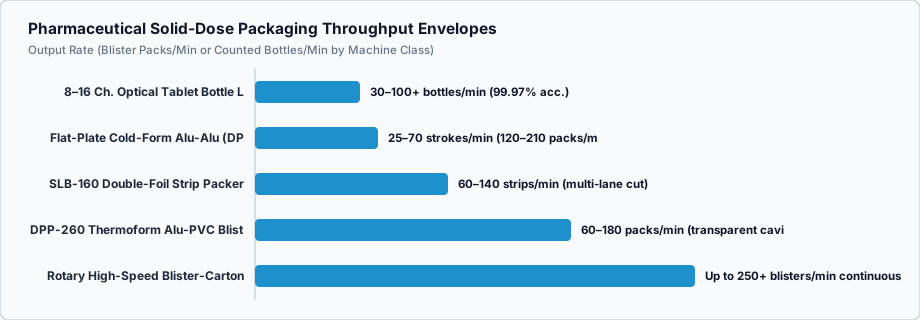
Explore related cGMP systems in Pharma Packing Machines, cGMP Barrier & Validation, or send your dosage specs via Project Brief.
Related Specifications
Further Reference
Verify Dimensions & Operating Ratings
Send your target envelope, load requirements, and ambient environment to review matching configurations.