Pharmaceutical Foil Barrier Physics, Seal Integrity & IQ/OQ Validation
Verify WVTR moisture barrier math (PVC vs PVDC vs Cold-Form Alu-Alu), >=7 N/15 mm heat-seal peel specs, <=35% cold-draw elongation limits, and 21 CFR Part 11.
Why Foil Draw Geometry & Heat-Seal Lacquer Physics Decide Stability Pass/Fail
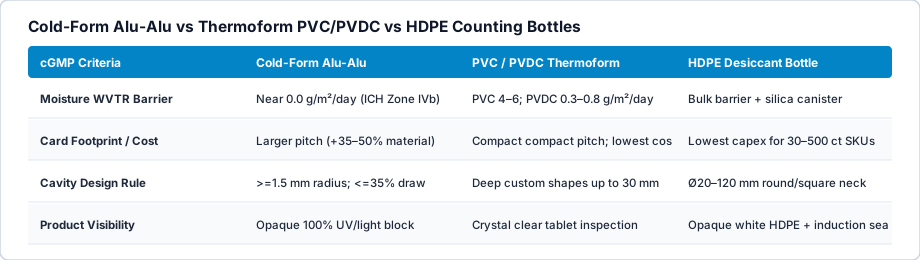
Stability failures in accelerated 40 °C / 75% RH chambers trace back to two measurable packaging parameters: polymer moisture permeation (4–6 g/m²/day across standard 0.25 mm PVC) or micro-delamination / corner pinholing on poorly engineered cold-form Alu-Alu tooling. Cold-forming multilayer OPA 25 μm / Alu 45–60 μm / PVC 60 μm stretches solid aluminum at room temperature—exceeding 35–40% elongation or machining mold corner radii tighter than 1.5 mm fractures the aluminum core and ruins sterility.
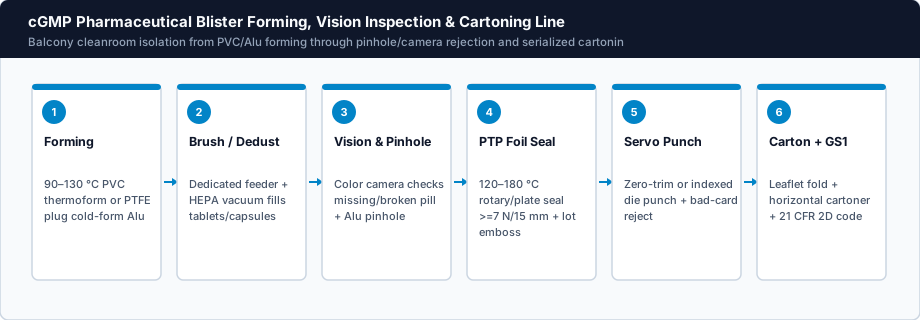
Downstream at the sealing station, insufficient platen pressure (<0.5 MPa), uncalibrated temperature outside the 120–180 °C heat-seal lacquer (HSL) window, or coarse knurling drops peel strength below the >=7 N/15 mm pharmacopeia integrity threshold.
cGMP Material, Forming & Regulatory Validation Reference
Critical process windows for pharmaceutical blister and counting validation:
| Validation Parameter | Target Engineering Window | Failure Mode Outside Window | Verification Method |
|---|---|---|---|
| Cold-Form Cavity Radius & Draw | >=1.5 mm corner radius; <=35–40% draw | Aluminum necking & micro-pinholes | Backlit UV/optical pinhole detector |
| PTP Lidding Seal Strength | >=7 N / 15 mm peel @ 120–180 °C | Channel delamination in stability | Tensile peel + methylene-blue -0.08 MPa |
| 0.25 mm PVC vs PVDC vs Alu-Alu | WVTR: 4–6 vs 0.4 vs ~0.0 g/m²/day | API hydrolysis / tablet softening | ICH Q1A 6-month accelerated chamber |
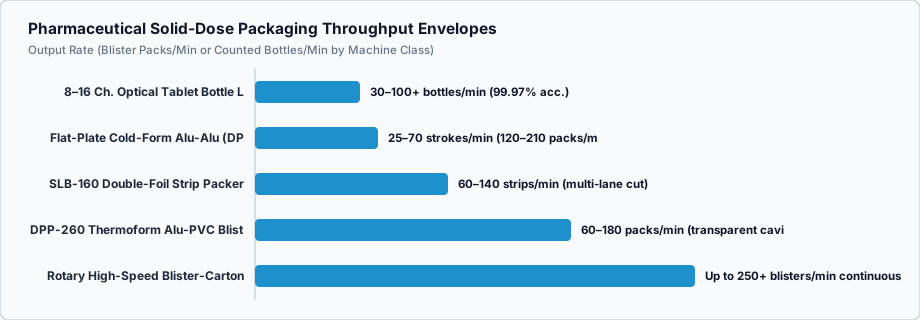
| Optical Counter Accuracy | 99.95%–99.97% + dust compensation | Short-count recall complaint | 100-bottle challenge + checkweigher |
| 21 CFR Part 11 / Annex 11 HMI | 3-tier RBAC, timestamped audit log | Data-integrity observation (483) | CSV / IQ / OQ challenge script |
Calculate blister card pitch, strokes/min, and foil roll consumption in our blister web layout and speed calculator.
cGMP Cleanroom & Validation Notes
- Separate Chilled-Water Cooling Circuit: Sealing plates run 120–180 °C inches away from formed PVC cavities—independent 12–18 °C chilled-water circuits prevent heat creep from warping blisters or degrading thermolabile biologics.
- Fine 0.25 mm Mesh vs Coarse 0.40 mm Knurling: Upgrading sealing-plate knurling mesh from 0.40 mm to fine 0.25 mm eliminates micro-capillary leak channels along blister borders.
- Complete DQ / FAT / IQ / OQ Turnkey Binders: Machines ship with weld boroscope logs, SUS316L mill certificates (
Ra <= 0.4–0.6 μm), food/FDA silicone gasket certs, and traceable sensor calibration sheets.
Review Your API Barrier & Validation Scope
Send your tablet dimensions and target market regulatory standard via Project Brief or explore pharma line sizing and compliance.
Explore related cGMP systems in Pharma Packing Machines, cGMP Barrier & Validation, or send your dosage specs via Project Brief.
In This Section
Further Reference
Verify Dimensions & Operating Ratings
Send your target envelope, load requirements, and ambient environment to review matching configurations.